Some designers use Figma the way a person with a hammer sees every problem as a nail. Figma is a great tool. But being unable to work with strategy, sketches, wireframes, or text-based specifications is a serious problem in the world of agentic design.
Don’t get me wrong, I have deep respect for designers who make magic in Figma. The craft is real. The years of practice are real. None of that is going away, and I would not be the one to argue that it should.
But there is a question worth sitting with.
“If your spinal-cord response to any design task is to open Figma and start drawing, you are not doing product development with agents anywhere near as effectively as you could be.”
This is not about being less of a designer. It is about taking a step back and looking at when Figma actually creates value, and when reaching for it too early quietly works against you.
Designing is more than visuals. It is product vision. User analysis. Solid wireframes that prove the structure before anyone shades a single pixel.
Preparation before designing matters more now that agents have entered the scene
If you skip those steps and go straight to Figma, the visual work risks being pointless. The flow on screen looks beautiful, but if the flow does not solve the user’s actual problem, it will not bring value to the business. Then your work perfecting the visual design is wasted.
“A stunning design on a bad idea is just a little prettier but still a costly mistake.”
I have made that mistake. Every designer I know has made that mistake. It is easy to make. The act of drawing feels productive. It produces artifacts. It generates progress. It is hard to step back from a beautiful screen and ask whether the underlying idea is even right. But now, with agents, every second of the designer’s focus matters. And the cost of going in the wrong direction is indefensible.
That is the trap the Figma-first spinal-cord reflex sets for us.
Are your Figma artboards the opportunity, or actually the bottleneck?
There is another cost that creeps up while you are drawing. It does not land on your screen. It lands on the team around you.
Greg Nudelman put it bluntly in a piece that reached 160,000 readers and over a thousand comments on LinkedIn:
“If you, as a UX designer, are seen as somebody who is continuously slowing down the release process in favor of adding decoration, instead of speeding up and streamlining delivery of value, you are going to be seen as a bottleneck.”
The harsh reality is this. If your default move is to design every page in Figma before the build can start, you are doing it wrong. Adding details manually makes you the obstacle for the other team members as well as for the agents. This is not a position I want to see designers placed in. The team waits on you. The release waits on you. The decoration arrives before the structure has been proven. From the product manager’s seat, from the engineer’s seat, from the stakeholder’s seat, you start to look like the thing that has to be cleared before value can ship.
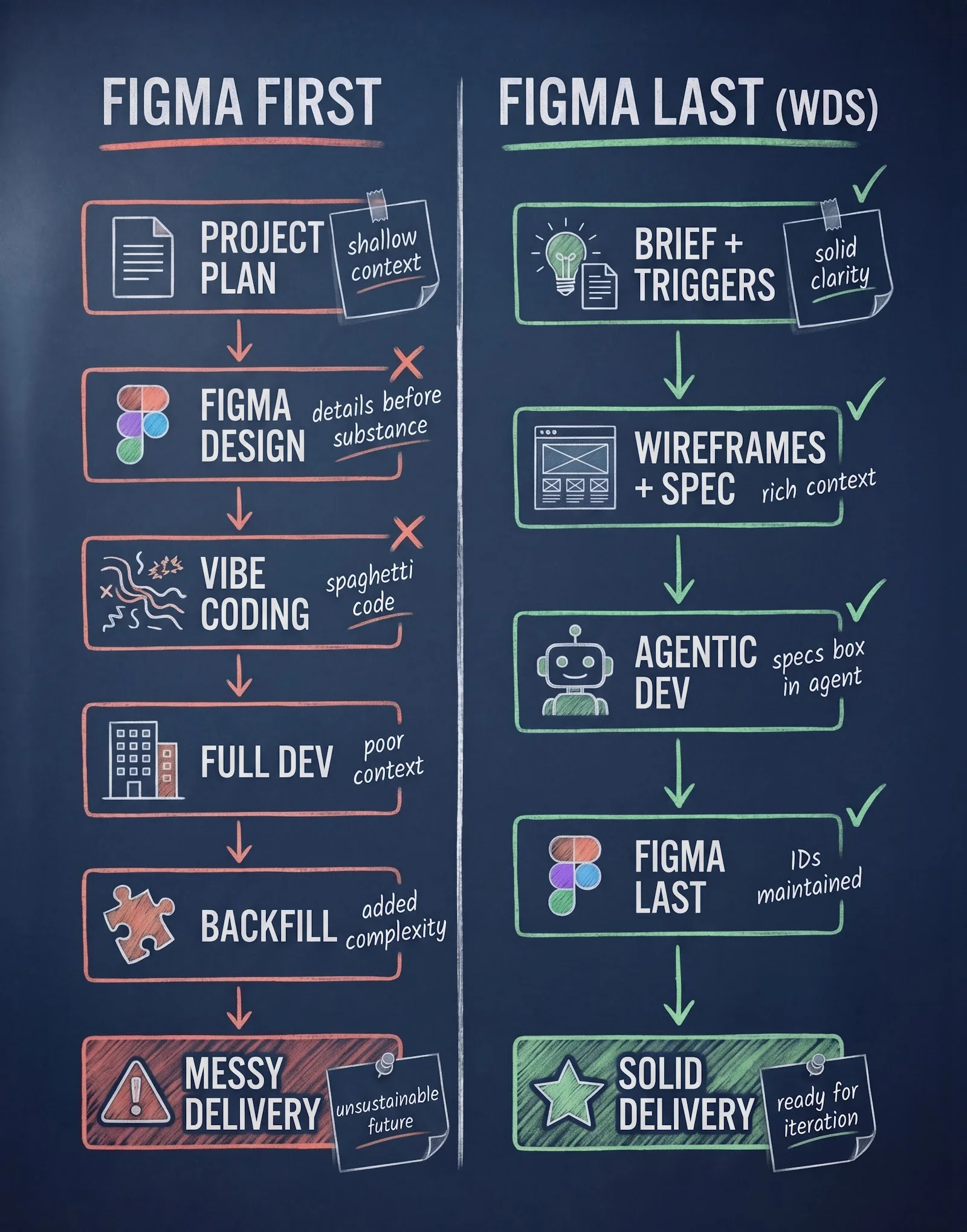
With agents, this gets worse, not better. All-views-in-Figma-before-build is directly antithetical to how agentic delivery works, for the systematic reasons I make the case for in Figma first is killing your agentic design workflow.
“As designers we should teach our agents to deliver the design that matters, not stand in the agents’ way!”
The fix is not to design less. It is to design earlier in a form the team can move on, and to save the visual decisions for the moment the structure is proven.
There is a better way
The shift is not “stop using Figma”. The shift is “use Figma later, on something you already know works”.
Here is what that looks like in practice.
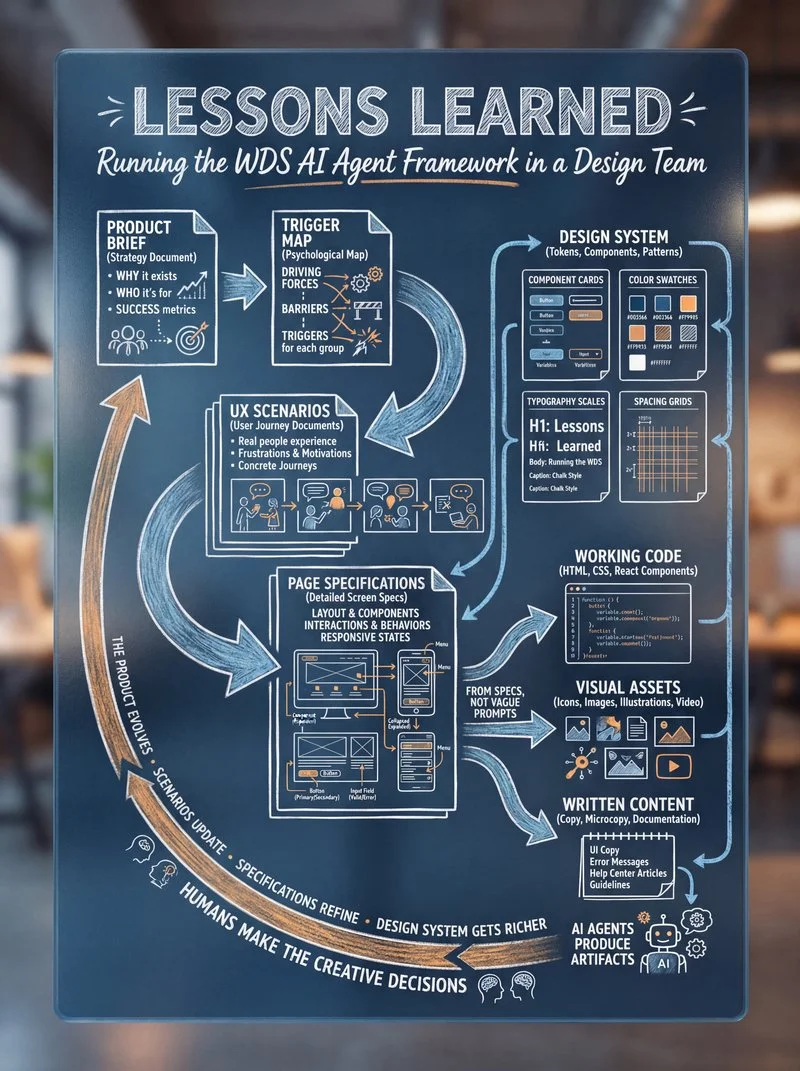
Get clarity with the help of agents. Use an agent to interrogate the project vision. To stress-test the user analysis. To turn fuzzy intent into a structured Product Brief, a Trigger Map, and UX Scenarios that walk through the actual flows from the actual user’s point of view. Agents are infinitely patient. They will challenge you, ask the questions you wanted to skip, and surface the gaps in your thinking before they become gaps in your design.
Outline the app in code. Once the strategy is sound, let the agents scaffold the structure. Real routes. Real components. Real flows you can click through. Not pictures of an app. The actual app, rough but running.
Open that code in Figma. Now Figma matters again, and matters more than ever. You are not drawing each object from scratch. You are picking up a structure that is already proven, and giving it the visual direction only you can give. Your taste. Your judgement. Your years of practice making the visual call from a position of knowledge rather than hope.
“Give visual direction on something you have already seen running and know works.”
That is when Figma magic pays off the most. Not at the beginning, when the idea is still smoke. At the moment when the idea has earned its keep.
I made the full systematic case for this order in Figma first is killing your agentic design workflow. If this piece resonated and you want the playbook, that is where it lives.
Have the agents work for you
This is the move I want every designer to make. Not “give up Figma”. Not “code instead of design”. Not “let the agents replace you”.
“Have the agents work for you! You are the lead because you know what great looks like!”
You stay the brain. The agents become the hands. You hold the product vision. You feel the friction in the flow. You push back when a stakeholder asks for something that will confuse users. The agents execute at machine speed on a clear brief, and the brief is yours.
I know this is a hard ask. I know, because I made the leap almost a year ago. I opened my mind to the agentic process, and walking that path is what led me to build WDS.
Whiteport Design Studio, the official UX framework for the BMad method, is the framework I built for exactly this. Free, open source, a complete set of phases for designers and agents to work the same way: Product Brief, Trigger Map, UX Scenarios, Design Loop. Strategy in markdown. Wireframes and specs with copy already written. Design system in code. Figma last, opened only when the system does not yet cover what you need.
Give WDS one day
WDS includes a full tutorial, the agents you need, and a process you can learn in one day. It might not be perfect for you. But every designer can set aside one day to learn.
Here is the on-ramp.
- Download a code-aware editor: VS Code, Cursor, or Antigravity.
- Pick a capable model. Claude Sonnet 4.6 or Opus 4.7 will do.
- Open a fresh project folder and paste this prompt to your agent:
I am a designer, proficient in Figma but new to working with AI agents. I want to learn WDS, the official UX framework for the BMad method, together with you. The WDS repo is at github.com/whiteport-collective/whiteport-design-studio and the full course lives in docs/learn/. Please help me install it and the tools I need, teach me how to set up GitHub for agentic design and development, walk me through the WDS Learn section step by step, and coach me through the full process until I am ready to use it in my real design work. Take it slow. Assume nothing. Ask before you skip ahead. Where do we start?One day. One agent. One designer on the other side of the leap.
Figma is not going away. But if you as a designer are not adapting, your Figma skills won’t matter much.
If you are a Figma wizard, your craft is more valuable than ever. It is just that the highest-leverage moment for that craft sits later in the process than the spinal-cord reflex would have you believe.
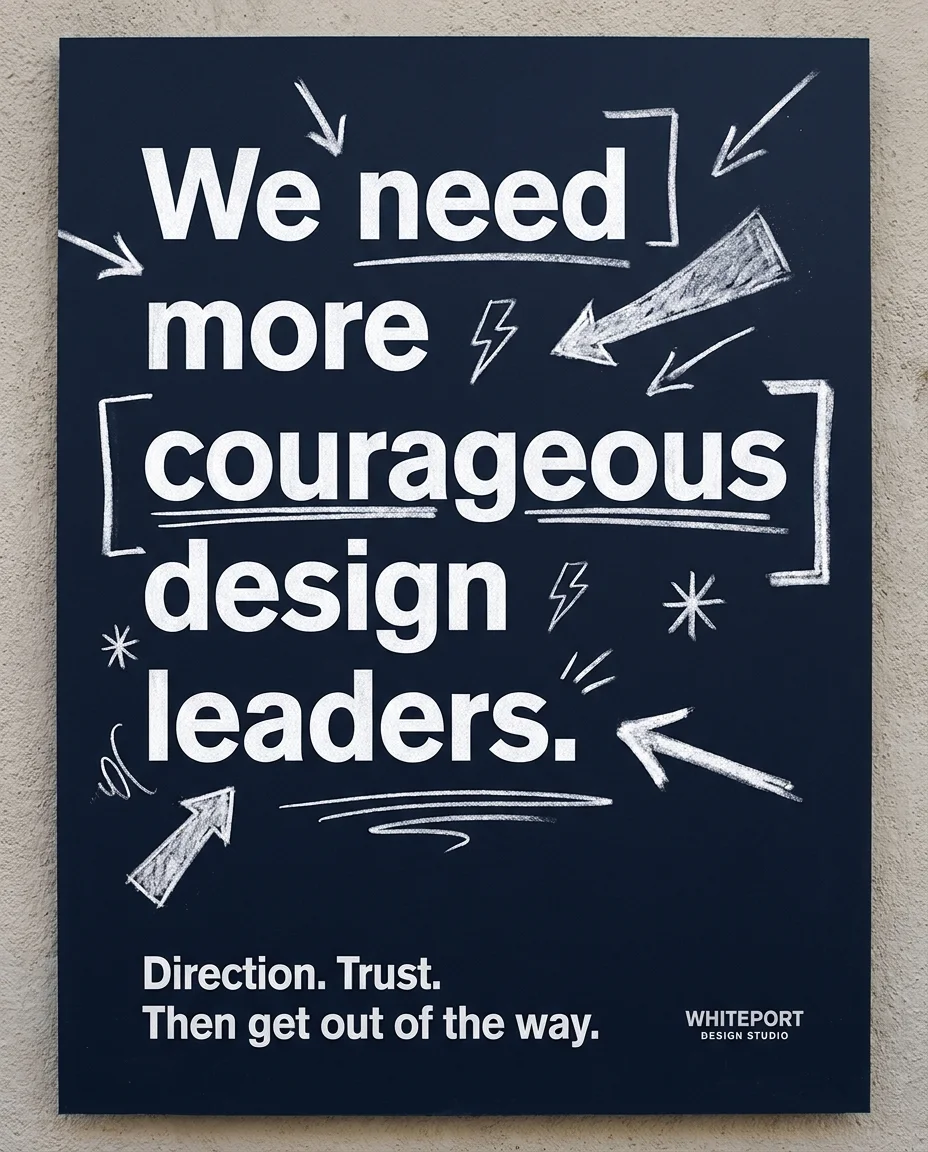
The designers who take a step back, learn how to use agents, and put their Figma magic at the right step will not just survive the agentic shift. They will lead it.
The argument has run out
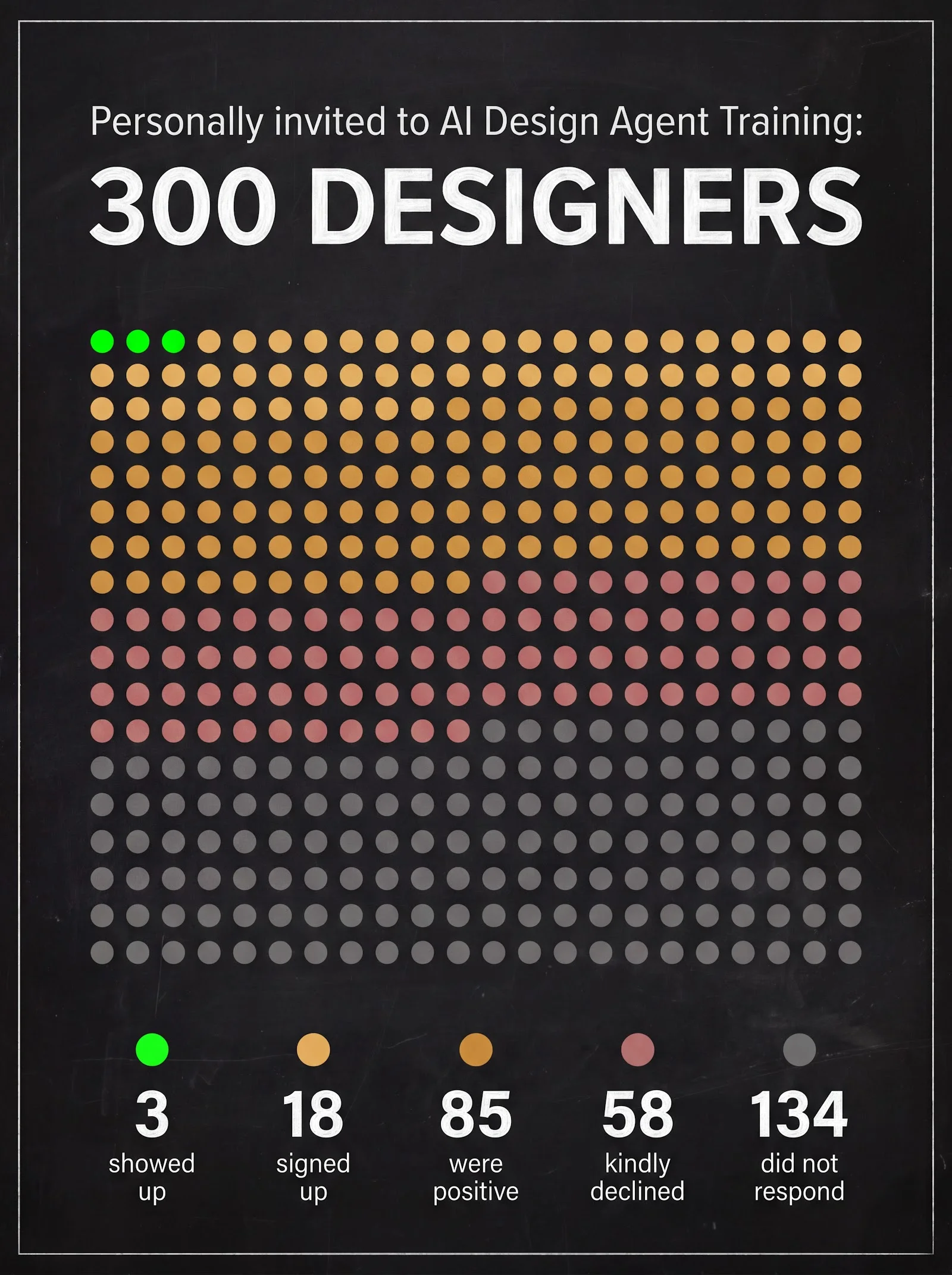
I will not pretend this is easy. It is not. But there is no longer a credible argument for avoiding agentic design as a designer.
If you have a better path, take it. Genuinely. Whatever gets you across the gap is the right tool for you.
But if you do not have a better path, and at this point you still choose not to act, the consequences are yours to own.
JOLO. You get one shot at this shift. Give WDS one day. Or give the alternative one day. Just do something.
If you recognize yourself in this and want to talk about how it feels from your seat, I’d love to hear from you. These conversations are some of the best parts of my week.
Read more
- Whiteport Design Studio (WDS), the official UX framework for the BMad method. Free and open source.
- BMad Method, the agentic development framework WDS is built on.
- Figma first is killing your agentic design workflow, the case for putting Figma last.
- Greg Nudelman: 160,000 People Read This Last Year. The Situation Got Worse, an external voice making a louder version of the same case.
- A great dialog about agentic design in teams, why the same questions show up at every scale.
- Agentisk design kräver inte bättre verktyg. Det kräver nytt ledarskap., what leadership needs to change to make the shift work.